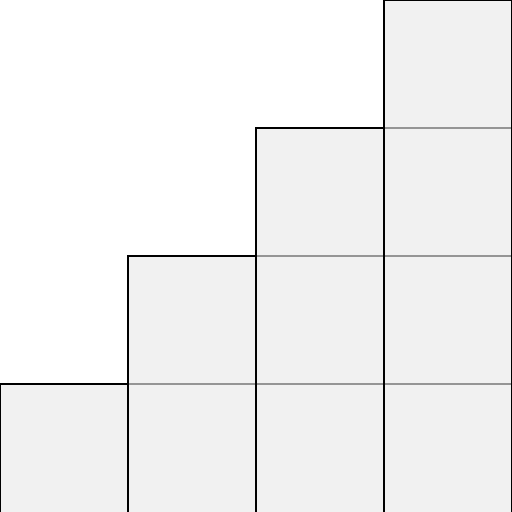
Think about each integer as an area, and draw each component integer of
Ln ascending, in a square of dimension
n:
In this case,
n=4 and
L4=10.
Notice the diagonal set of squares from the bottom left to the top right of the greater square.
There exist
n units on this diagonal.
Above the diagonal, there are zero units as part of the greater square.
Below the diagonal, all units are part of the greater square.
We know the diagonal has a total area of
n, but what about the area under the diagonal?
If we consider the greater square with the diagonal removed, then this under-area is clearly half of the greater square’s (sans diagonal) area.
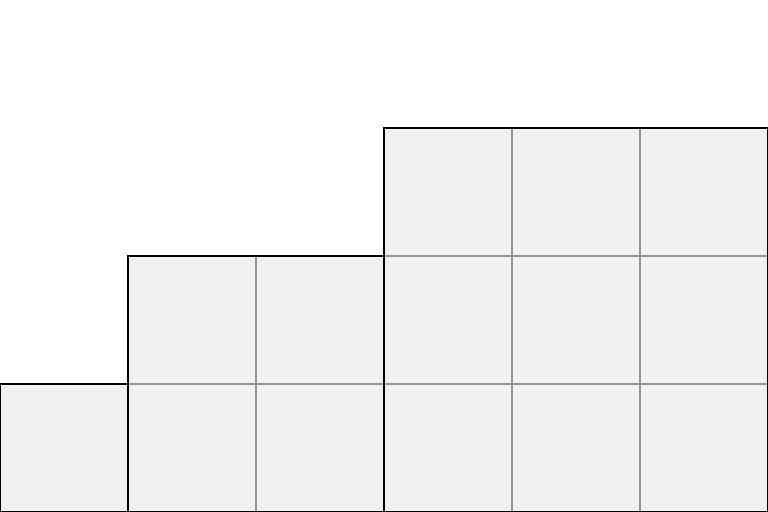
Thing about each squared integer as a square. Arrange them ascending:
In this case,
n=3 and
S3=14.
Just as with the un-squared natural numbers, a closed form for
Sn can be found by interpreting this geometric construction.
If a equation for the quantity of units in each row
Rj is found, then the total
Sn is the sum of the row
Rj values.
Where
j is the row number, from bottom up, starting at
0:
Sn=R0+R1+…+Rn−1
For the bottom row (
j=0),
R0,3=L3 (where
Ln is the sum of natural numbers from 1…n) or
R0,3=232+3
For the following values of
j>0,
Rj will decrease.
Each increase of
j will cause a subsequent quantity to be removed:
Rj=2n2+n−2j2+j
Again, recall that
Sn=R0+R1+…+Rn−1
Substituting in,
Rj we see:
Sn=n(2n2+n)−202+0−212+1−…−2(n−1)2+(n−1)
Factor
Sn=21(n(n2+n)−(02+12+…+(n−1)2)−(0+1+…+(n−1)))
The sum of natural numbers of the right of the equation can be simplified to
Ln−1 and the sum of squares on the left can be simplified to
Sn−1